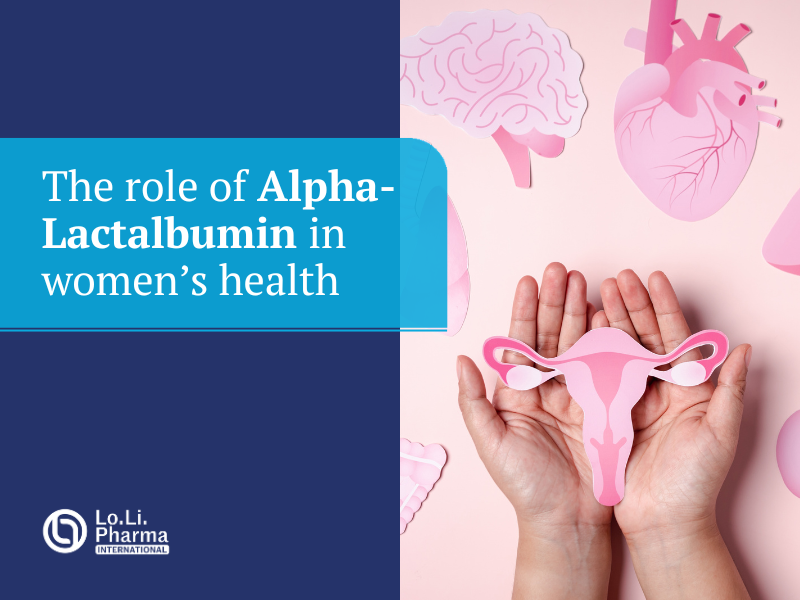
Alpha-lactalbumin is gaining attention in nutraceutical research for its biological properties and its potential role in formulation design. It is a whey protein naturally present in mammalian milk, particularly abundant in human milk, and characterized by a high nutritional value due to its amino acid composition (Cardinale et al., 2022).
During digestion, alpha-lactalbumin can generate bioactive peptides associated with several physiological activities, including antibacterial, anti-inflammatory, immunomodulatory and microbiota-related effects (Cardinale et al., 2022). These properties make it particularly interesting in women’s health, where intestinal balance, metabolism and nutrient availability can influence endocrine and reproductive function.
This perspective becomes particularly relevant in PMOS, a condition in which reproductive, hormonal, metabolic and intestinal factors can coexist. In this context, alpha-lactalbumin is not introduced as a stand-alone solution, but as a bioactive protein with potential relevance for formulations designed around intestinal interaction, absorption and the delivery of selected active ingredients.
A bioactive protein beyond nutrition
The interest in alpha-lactalbumin is linked to its ability to interact with different biological systems.
Its amino acid profile includes essential amino acids such as tryptophan, lysine, branched-chain amino acids and sulfur-containing amino acids, which are involved in protein synthesis, antioxidant pathways and neurological functions (Cardinale et al., 2022).
Alpha-lactalbumin-derived peptides have also been discussed for their potential effects on bacterial growth, immune modulation and inflammatory processes. A recent systematic review on dairy-derived bioactive peptides highlighted milk proteins as important precursors of peptides with multiple functional activities, including antimicrobial, antioxidant, immunomodulatory and metabolic effects. Alpha-lactalbumin was included among the relevant protein precursors (Meleti et al., 2025)
For nutraceutical development, this is a relevant point: alpha-lactalbumin has its own biological identity and may contribute to the functional rationale of a formulation.
Alpha-Lactalbumin and the intestinal environment
The intestinal environment plays a key role in the bioavailability of many compounds. Absorption, barrier function and microbiota composition can influence how an active ingredient is absorbed and used by the body.
Alpha-lactalbumin is relevant in this area because it has been discussed for its potential prebiotic effects and for its ability to support beneficial bacterial populations, with possible implications for microbiota balance (Cardinale et al., 2022).
Its role as a carrier has also been explored in relation to other active compounds. For example, alpha-lactalbumin has been investigated as a carrier for vitamin D3 food enrichment, supporting the broader interest in this protein as a functional component for improving the delivery of selected bioactives (Delavari et al., 2015).
Recent formulation research has also explored alpha-lactalbumin as a delivery-oriented protein. Self-assembled alpha-lactalbumin nanostructures have been studied for the encapsulation and controlled release of bioactive molecules in gastrointestinal in vitro models, showing an experimental potential that still requires further optimization (de Oliveira Bianchi et al., 2024).
This intestinal perspective is important because, in many nutraceutical applications, the value of an ingredient depends also on how effectively it can support the availability of other active compounds.
Why it matters in PMOS
This perspective becomes particularly relevant in polyendocrine metabolic ovarian syndrome (PMOS), the new name for the condition previously referred to as polycystic ovary syndrome (PCOS). Most studies cited in this article were published before the terminology change and therefore use the former name PCOS (Teede et al., 2026).
PMOS is a complex endocrine and metabolic condition involving reproductive, hormonal, metabolic and intestinal components. Studies published have described frequent associations with ovulatory dysfunction, hyperandrogenism, insulin resistance and metabolic disturbances (Montanino Oliva et al., 2018; Kamenov et al., 2023).
Intestinal factors are also increasingly relevant. Cardinale et al. reported that women with PMOS may show gastrointestinal dysbiosis, which can contribute to insulin resistance, inflammation and hormonal imbalance. In the same review, alpha-lactalbumin is discussed as a molecule of interest because of its potential prebiotic activity and its role in microbiota-related mechanisms (Cardinale et al., 2022).
Alpha-lactalbumin should not be presented as a stand-alone solution for PMOS. Its value is better understood within integrated nutraceutical strategies, where intestinal absorption, microbiota and metabolic balance are part of the formulation rationale.
Alpha-Lactalbumin and inositol resistance
Myo-inositol is one of the most studied molecules in PMOS-related research. It is involved in insulin signaling, glucose metabolism and follicle-stimulating hormone pathways, which explains its use in studies focused on ovarian function, menstrual regularity and fertility (Kamenov et al., 2023).
However, response to myo-inositol supplementation is not uniform. Some women do not experience the expected restoration of ovulation after standard supplementation, a phenomenon described as inositol resistance (Montanino Oliva et al., 2018; Kamenov et al., 2023).
This is where alpha-lactalbumin becomes clinically relevant. Monastra et al. investigated its effect on myo-inositol intestinal absorption in vivo and in vitro. In healthy volunteers, plasma concentrations of myo-inositol were significantly higher when myo-inositol was taken with alpha-lactalbumin compared with myo-inositol alone. In Caco-2 intestinal cells, digested alpha-lactalbumin improved myo-inositol passage, with a proposed involvement of tight junction permeability (Monastra et al., 2018).
In an open prospective study conducted on women with PMOS, anovulation and infertility, patients first received myo-inositol alone for three months. At the end of this phase, 23 out of 37 women ovulated, while 14 did not restore ovulation and were classified as myo-inositol-resistant. In this subgroup, plasma myo-inositol levels did not increase (Montanino Oliva et al., 2018).
The same resistant patients then received myo-inositol combined with alpha-lactalbumin for another three months. After the combined treatment, 12 out of 14 women restored ovulation, and plasma myo-inositol levels increased significantly. Improvements in hormonal and lipid parameters were also recorded (Montanino Oliva et al., 2018).
Kamenov et al. further investigated this approach in anovulatory women with PMOS by comparing myo-inositol plus alpha-lactalbumin with myo-inositol alone. The combined treatment showed better outcomes in terms of ovulation rate and menstrual cycle duration. The study also reported improvements in body weight and hyperandrogenism, suggesting that alpha-lactalbumin may enhance the clinical response to myo-inositol supplementation (Kamenov et al., 2023).
These findings should be interpreted with attention to study design and sample size. Still, they support a coherent formulation hypothesis: in selected patients, the key point may not be providing more myo-inositol but improving how myo-inositol becomes available to the body.
A patented formulation approach
The combination of myo-inositol and alpha-lactalbumin is also supported by a patented formulation approach, with patents granted in several countries.
This aspect is relevant because it reflects a precise formulation strategy: using alpha-lactalbumin to support intestinal absorption and improve myo-inositol bioavailability in patients who may show a limited response to standard supplementation.
For healthcare professionals, this connects pharmacokinetic evidence, intestinal absorption and clinical response. For international partners and distributors, it identifies a formulation concept based on scientific research and protected by intellectual property, while maintaining a clear positioning in women’s health.
Conclusion
Alpha-lactalbumin brings together nutritional value, bioactive peptide generation, microbiota-related potential and documented effects on myo-inositol absorption. This makes it a relevant ingredient in nutraceutical strategies for women’s health, especially in areas such as PMOS, where reproductive, endocrine, metabolic and intestinal factors may overlap.
Its role is particularly meaningful when formulation is designed around bioavailability. In the context of inositol resistance, the available evidence suggests that the key point may not be providing more myo-inositol, but improving how myo-inositol becomes available to the body. Further studies are needed to better define which patients may benefit most from this approach.
Bibliography:
Cardinale, V., Lepore, E., Basciani, S., Artale, S., Nordio, M., Bizzarri, M., Unfer, V. Positive Effects of α-Lactalbumin in the Management of Symptoms of Polycystic Ovary Syndrome. Nutrients. 2022;14:3220. doi: 10.3390/nu14153220.
Meleti, E., Koureas, M., Manouras, A., Giannouli, P., Malissiova, E. Bioactive Peptides from Dairy Products: A Systematic Review of Advances, Mechanisms, Benefits, and Functional Potential. Dairy. 2025;6(6):65. doi: 10.3390/dairy6060065.
Delavari, B., Saboury, A.A., Atri, M.S., Ghasemi, A., Bigdeli, B., Khammari, A., Maghami, P., Moosavi-Movahedi, A.A., Haertlé, T., Goliaei, B. Alpha-lactalbumin: A new carrier for vitamin D3 food enrichment. Food Hydrocolloids. 2015;45:124–131. doi: 10.1016/j.foodhyd.2014.10.017.
de Oliveira Bianchi, J.R., Fabrino, D.L., Finzi Quintão, C.M., dos Reis Coimbra, J.S., Santos, I.J.B. Self-assembled α-lactalbumin nanostructures: encapsulation and controlled release of bioactive molecules in gastrointestinal in vitro model. Journal of the Science of Food and Agriculture. 2024;104(15):9592–9602. doi: 10.1002/jsfa.13784.
Teede, H.J., Bahri Khomami, M., Morman, R., Laven, J.S.E., Joham, A.E., Costello, M.F., Patil, M., Rees, D.A., Berry, L., Cree, M.G., Zhao, H., Norman, R.J., Dokras, A., Piltonen, T.; Global Name Change Consortium. Polyendocrine metabolic ovarian syndrome, the new name for polycystic ovary syndrome: a multistep global consensus process. The Lancet. 2026. doi: 10.1016/S0140-6736(26)00717-8.
Montanino Oliva, M., Buonomo, G., Calcagno, M., Unfer, V. Effects of myo-inositol plus alpha-lactalbumin in myo-inositol-resistant PCOS women. Journal of Ovarian Research. 2018;11:38. doi: 10.1186/s13048-018-0411-2.
Kamenov, Z., Gateva, A., Dinicola, S., Unfer, V. Comparing the Efficacy of Myo-Inositol Plus α-Lactalbumin vs. Myo-Inositol Alone on Reproductive and Metabolic Disturbances of Polycystic Ovary Syndrome. Metabolites. 2023;13:717. doi: 10.3390/metabo13060717.
Monastra, G., Sambuy, Y., Ferruzza, S., Ferrari, D., Ranaldi, G. Alpha-lactalbumin Effect on Myo-inositol Intestinal Absorption: In vivo and In vitro. Current Drug Delivery. 2018;15(9):1305–1311. doi: 10.2174/1567201815666180509102641.509102641509102641.