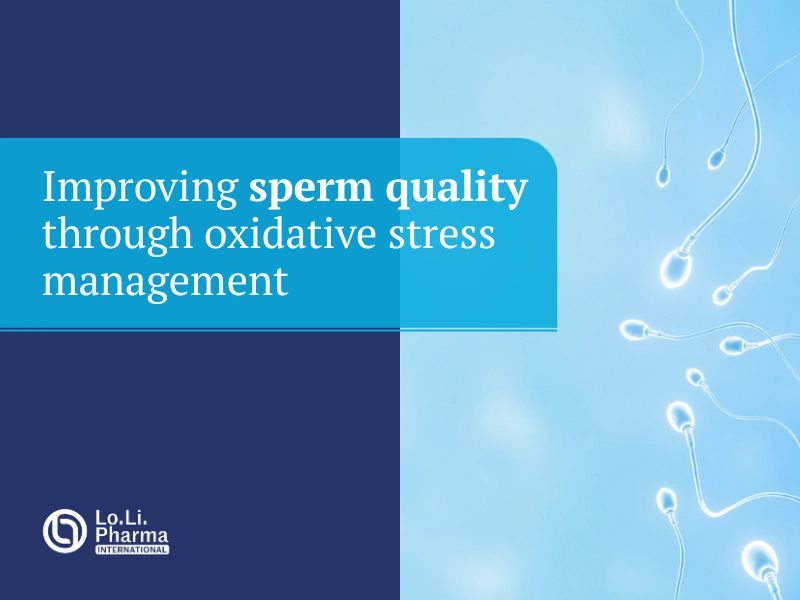
Infertility is a significant global health concern, affecting roughly 8–12% of couples of childbearing age, with male factors contributing to nearly 50% of cases (Wang et al., 2025). Sperm quality is strongly influenced by oxidative stress, a biological process that can affect sperm motility, sperm morphology, DNA integrity, and overall male reproductive health.
Reactive oxygen species (ROS) have a physiological role in the male reproductive system. At controlled levels, they support sperm capacitation, hyperactivation, acrosome reaction, and fertilization. When ROS production exceeds antioxidant defenses, however, the same molecules can damage sperm membranes, proteins, mitochondria, and DNA (Wang et al., 2025).
For this reason, improving sperm quality does not mean eliminating free radicals completely. The goal is to maintain redox balance: preserving the signaling functions of ROS while limiting oxidative damage. This shifts the focus from traditional antioxidants toward a broader view of sperm health centred on mitochondrial efficiency, DNA protection, and cellular homeostasis. Within this view, molecules such as myo-inositol are gaining attention because they combine antioxidant support with help for the cellular mechanisms that sustain sperm function (Governini et al., 2020; Ghaemi et al., 2024).
How does oxidative stress affect sperm quality?
Why sperm cells are highly vulnerable to oxidative stress
Spermatozoa are highly sensitive to oxidative stress. Their plasma membrane is rich in polyunsaturated fatty acids, which are essential for flexibility and fertilization but are also prone to lipid peroxidation. At the same time, sperm cells have limited cytoplasmic volume and reduced antioxidant defenses, making them less able to counteract excessive ROS (Wang et al., 2025; Dimitriadis et al., 2023).
Sperm mitochondria add another critical layer. They support ATP production, but they are also a major source of ROS. When mitochondrial function is impaired, ROS production can increase, ATP availability can decrease, and sperm movement can be compromised.
The impact on sperm motility, morphology, and DNA integrity
Oxidative stress affects several semen parameters:
- Lipid peroxidation reduces membrane fluidity, making spermatozoa less able to move efficiently and interact with the oocyte.
- Protein oxidation can affect structural proteins involved in sperm movement and shape, contributing to impaired motility and altered morphology.
- DNA integrity is also vulnerable. ROS can induce oxidative base lesions and DNA fragmentation. Since spermatozoa have limited DNA repair capacity, oxidative damage may reduce fertilizing potential and affect reproductive outcomes (Wang et al., 2025).
Key oxidative stress markers and fertility biomarkers
Oxidative stress marker evaluation can add functional context to semen analysis:
- 8-OHdG (8-hydroxy-2′-deoxyguanosine) reflects oxidative DNA damage.
- MDA (malondialdehyde) reflects lipid peroxidation.
These fertility biomarkers may help identify an oxidative component behind reduced sperm quality, although their routine clinical use still requires stronger standardization and clearer thresholds (Zikopoulos et al., 2026).
Which nutrients can support sperm quality and male reproductive health?
The role of antioxidants in male fertility
Antioxidants remain central in the management of oxidative stress. Among the nutrients most frequently studied in male fertility supplements are vitamin C, vitamin E, selenium, zinc, carnitines, CoQ10, N-acetylcysteine, folate, and lycopene (Dimitriadis et al., 2023).
Their role is to help neutralize excessive ROS, protect membranes, reduce lipid peroxidation, and limit oxidative damage to proteins and DNA. The systematic review by Dimitriadis et al. (2023) reported positive effects of antioxidant supplementation in several studies involving semen parameters, assisted reproductive technology outcomes, and live birth rate.
That same review also noted inconsistent results across some studies, suggesting that response may depend on formulation, dose, duration, and baseline oxidative status.
Why antioxidants alone may not be enough
An approach based only on antioxidants may be incomplete. Excess ROS can arise from deeper cellular dysfunctions, including impaired mitochondrial activity, inflammation, metabolic imbalance, and disrupted cellular signaling.
This is especially relevant for sperm mitochondria. If mitochondrial respiration remains inefficient, oxidative stress may continue at its source. Reducing ROS after they are formed may therefore be less effective than combining antioxidant protection with support for the cellular mechanisms that influence sperm motility, DNA integrity, and overall sperm health.
From redox balance to cellular function
A more advanced view of male reproductive health combines redox balance with cellular function. The objective is to protect spermatozoa from oxidative damage while supporting the biological processes required for motility, fertilization, and DNA integrity.
Cellular signaling also plays an important role in sperm function. Altered intracellular calcium homeostasis is closely linked to oxidative stress, mitochondrial dysfunction, and impaired sperm motility and viability, highlighting the importance of calcium-regulated pathways in male reproductive health (Bravo et al., 2026).
Why are sperm mitochondria central to reproductive health?
The connection between sperm mitochondria and ATP production
Sperm mitochondria are essential for energy production. Through oxidative phosphorylation, they generate ATP, which supports flagellar movement and progressive motility. When mitochondrial respiration is efficient, sperm cells are better equipped to sustain the movement required for fertilization.
Their relevance, however, goes beyond energy production. Sperm mitochondria are both a source and a target of oxidative stress, which makes them central to the cycle linking ROS overproduction, ATP depletion, and impaired sperm function.
How mitochondrial dysfunction contributes to male conception challenges
Mitochondrial dysfunction can reduce sperm motility, impair fertilizing capacity, and increase susceptibility to sperm DNA damage. Elevated mitochondrial ROS may damage mitochondrial DNA and weaken the energy metabolism required for sperm function (Wang et al., 2025). Excessive ROS can also lower the mitochondrial membrane potential, further reducing sperm motility (Governini et al., 2020).
This creates a self-reinforcing cycle: oxidative stress impairs mitochondria, damaged mitochondria generate more ROS, and sperm quality declines. Breaking this cycle requires a strategy that goes beyond simple radical scavenging.
A mitochondria-focused approach to reproductive wellness
Preserving mitochondria efficiency can give antioxidants a stronger biological context: antioxidants reduce oxidative pressure, while mitochondrial support preserves ATP production and sperm motility.
Together they point directly to myo-inositol, a molecule that acts on both fronts at once.
What are the myo-inositol benefits for sperm quality?
Myo-inositol and mitochondrial efficiency
The myo-inositol benefits for sperm quality are closely linked to mitochondrial function. In vitro research on human sperm showed that myo-inositol treatment increased progressive motility and oxygen consumption, an index of oxidative phosphorylation efficiency and ATP production (Governini et al., 2020).
This is clinically relevant because sperm motility is highly energy-dependent. By supporting mitochondrial activity, myo-inositol may help spermatozoa sustain the movement required for fertilization.
Myo-inositol fertility benefits beyond antioxidant activity
Myo-inositol research also points to mechanisms that extend beyond antioxidant activity. Myo-inositol is involved in cell membrane composition, lipid synthesis, and cellular signaling, and it has been associated with sperm motility, capacitation, maturation, and acrosome reaction (Ghaemi et al., 2024).
These mechanisms matter because sperm quality depends on energy metabolism, membrane integrity, DNA protection, and cellular homeostasis. Myo-inositol is therefore relevant because it connects redox balance with sperm function at multiple biological levels.
Evidence on sperm motility and DNA protection
A 2024 systematic review and meta-analysis found that myo-inositol significantly improved total and progressive sperm motility and reduced sperm DNA fragmentation, with higher testosterone levels in the included studies (Ghaemi et al., 2024).
In vitro, myo-inositol also protected sperm DNA from oxidative damage, lowering 8-OHdG levels (Governini et al., 2020). Clinical data in men with asthenospermia and metabolic syndrome point in the same direction, though small samples call for caution (Montanino Oliva et al., 2016).
The future of oxidative stress management in male fertility
Moving beyond traditional antioxidant strategies
The future of oxidative stress management in male fertility is likely to focus on balance, personalization, and cellular function. ROS are required for key reproductive processes, so the objective is to control excessive oxidative stress while preserving physiological signaling.
This approach may be strengthened by fertility biomarkers such as MDA, 8-OHdG, total antioxidant capacity, and inflammatory markers. These tools may help identify patients with a stronger oxidative or inflammatory component, supporting more targeted strategies (Zikopoulos et al., 2026).
Combining antioxidants, mitochondrial support, and cellular homeostasis
A more complete approach to sperm quality should combine three complementary actions:
- Antioxidants help protect spermatozoa from oxidative damage.
- Mitochondrial support helps sustain ATP production and sperm motility.
- Cellular homeostasis supports the signaling environment required for reproductive function.
This integrated view reflects the biology of spermatozoa more accurately than a single-mechanism model.
A new perspective on reproductive wellness
Male reproductive health should be assessed through both semen parameters and functional markers. Improving sperm quality requires more than increasing antioxidant intake. Antioxidants remain important for protecting sperm health, but they may be insufficient when oxidative damage is driven by mitochondrial dysfunction, altered cellular homeostasis, inflammation, or metabolic imbalance. A more complete strategy should address both ROS control and the cellular mechanisms that influence sperm function.
Myo-inositol fits within this perspective because the available evidence links it to sperm motility, mitochondrial respiration, reduced DNA fragmentation, and cellular signaling.
Strategies that combine oxidative stress management with support for mitochondrial efficiency and cellular homeostasis may offer a more comprehensive approach to sperm quality and reproductive wellness.
Bibliography:
Wang Y, Fu X, Li H. Mechanisms of oxidative stress-induced sperm dysfunction. Frontiers in Endocrinology. 2025;16:1520835. https://doi.org/10.3389/fendo.2025.1520835
Dimitriadis F, Borgmann H, Struck JP, Salem J, Kuru TH. Antioxidant Supplementation on Male Fertility: A Systematic Review. Antioxidants. 2023;12(4):836. https://doi.org/10.3390/antiox12040836
Governini L, Ponchia R, Artini PG, Casarosa E, Marzi I, Capaldo A, Luddi A, Piomboni P. Respiratory Mitochondrial Efficiency and DNA Oxidation in Human Sperm after In Vitro Myo-Inositol Treatment. Journal of Clinical Medicine. 2020;9(6):1638. https://doi.org/10.3390/jcm9061638
Ghaemi M, Seighali N, Shafiee A, Beiky M, Kohandel Gargari O, Azarboo A, et al. The effect of Myo-inositol on improving sperm quality and IVF outcomes: A systematic review and meta-analysis. Food Science & Nutrition. 2024. https://doi.org/10.1002/fsn3.4427
Montanino Oliva M, Minutolo E, Lippa A, Iaconianni P, Vaiarelli A. Effect of Myoinositol and Antioxidants on Sperm Quality in Men with Metabolic Syndrome. International Journal of Endocrinology. 2016;2016:1674950. https://doi.org/10.1155/2016/1674950
Bravo A, Jofré-Fernández I, Boguen R, Sánchez R, Zambrano F, Uribe P. Disruption of Calcium Homeostasis in Human Spermatozoa: Implications on Mitochondrial Bioenergetics, ROS Production, Phosphatidylserine Externalization, and Motility. Antioxidants. 2026;15(2):213. https://doi.org/10.3390/antiox15020213
Zikopoulos A, Christopoulos P, Kalampokas T, Gerede A, Moustakli E, Arkoulis I, et al. Oxidative Stress and Inflammatory Biomarkers in Male Infertility: A Narrative Review of Diagnostic Value and Clinical Integration. Diagnostics. 2026;16(4):527. https://doi.org/10.3390/diagnostics16040527