A long-term prevention priority for women’s health portfolios
Low bone mineral density was associated with an estimated 219,552 attributable deaths and 7.76 million disability-adjusted life years among postmenopausal women worldwide in 2021. (Liang et al., 2025)
Published in 2025, an analysis of Global Burden of Disease data brings the scale of skeletal fragility into focus. These are modeled population estimates, with uncertainty, rather than a count of deaths directly recorded as osteoporosis.
For distributors building women’s health portfolios, bone health after menopause deserves attention well beyond symptom-led care. Prevention involves repeated assessment and sustained habits. Nutritional support has a place where it addresses a documented need, within a wider approach to reducing fracture risk.
Why bone loss accelerates after menopause
Bone is living tissue that undergoes continuous renewal. Osteoclasts remove old bone, while osteoblasts form new tissue. Estrogen helps regulate this balance.
After menopause, estrogen deficiency increases bone turnover and can allow resorption to exceed formation, reducing bone mass and weakening its internal structure. (Zhang et al., 2022)
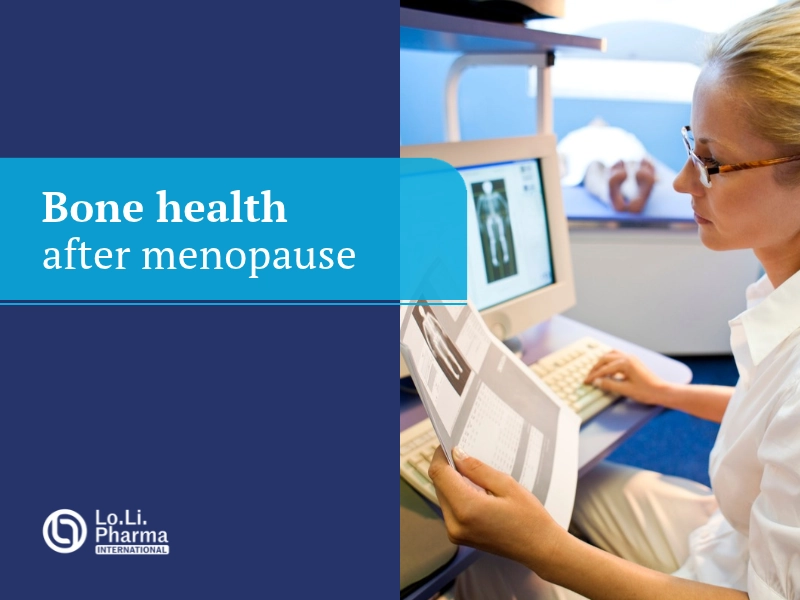
Bone mineral density measures the mineral content of bone and contributes to the assessment of skeletal strength. A DXA scan helps identify low density, but clinicians also consider age, previous fractures and other risk factors, usually combined through FRAX, a tool that estimates a woman’s 10-year probability of a hip fracture or another major osteoporotic fracture. (LeBoff et al., 2022a)
The objective is to estimate the likelihood of a future fracture and choose an appropriate response.
The absence of obvious symptoms makes early attention difficult. Women may seek menopause advice for hot flashes while remaining unaware of skeletal changes. A prevention discussion can bring bone health into that consultation before a fracture prompts investigation.
What the global burden means for prevention
A disability-adjusted life year, or DALY, measures lost healthy life by combining years lost through premature death with years lived with disability. The 7.76 million DALYs estimated in the GBD analysis therefore capture consequences beyond mortality, including the burden associated with impaired health and function.
The researchers examined 204 countries and territories and found that absolute deaths attributable to low bone mineral density more than doubled between 1990 and 2021, despite a slight decline in the age-standardized death rate. Population aging contributed to the increase. (Liang et al., 2025)
Because aging drives much of this burden, prevention matters at successive stages of life: a woman entering menopause and an older woman recovering from a fragility fracture need different assessments. Distributors should reflect those differences in product positioning and educational materials, avoiding a single undifferentiated message for all postmenopausal women.
Where bone health supplements fit
Nutritional support aims to meet requirements and correct inadequate intake or deficiency. Calcium and vitamin D have established roles in bone health, but supplementation decisions depend on diet, clinical circumstances and local guidance.
The VITAL trial shows why that need has to be documented. Among 25,871 adults in the United States who were not selected for vitamin D deficiency, low bone mass or osteoporosis, 2,000 IU of vitamin D a day for a median of 5.3 years did not lower the risk of total, nonvertebral or hip fractures compared with placebo. (LeBoff et al., 2022b) The result concerns an unselected population. Where intake or blood levels are low, the question changes, and establishing that deficit comes first.
A UK clinical guideline recommends dietary calcium where possible and supplementation when intake is insufficient. It also supports calcium or vitamin D as appropriate adjuncts to osteoporosis medication. (Gregson et al., 2025)
The preference for calcium from food reflects a long-running debate on the safety of high-dose calcium supplements, which have been linked to kidney stones and, less consistently, to cardiovascular events.
That role needs precise wording. A food supplement should carry claims supported by its composition and permitted locally. Evidence about an ingredient’s contribution to normal bone function cannot automatically substantiate a claim that a finished product prevents fractures.
The European Union offers a clear example of a proportionate claim. Under Regulation (EC) No 1924/2006, calcium and vitamin D carry an authorized disease risk reduction claim: “Calcium and vitamin D help to reduce the loss of bone mineral in post-menopausal women. Low bone mineral density is a risk factor for osteoporotic bone fractures.” The claim may be used only for products that provide a daily intake of at least 1,200 mg of calcium and 20 µg (800 IU) of vitamin D, and consumers must be told that it is targeted at women aged 50 and older. For a distributor, a claim of this kind is valuable because its wording, conditions and target population are fixed in advance.
Exercise also belongs in the discussion. A UK consensus statement supports resistance and impact exercise to promote bone strength, alongside balance training to reduce falls. Programs require adaptation to ability and fracture risk, especially in people with vertebral fractures. (Brooke-Wavell et al., 2022)
A useful educational program connects nutritional advice with physical activity and appropriate clinical referral. Women with osteoporosis or a previous fragility fracture may need pharmacological treatment and continuing review. (ACOG, 2021)
Menopausal hormone therapy also belongs in this picture. Beyond its effect on hot flashes, it prevents bone loss and reduces fractures, and the North American Menopause Society (now The Menopause Society) counts this among its benefits for appropriately selected women younger than 60 or within ten years of menopause. (The North American Menopause Society, 2022)
A growing market with a need for sustained use
Allied Market Research values the global bone health supplements market at USD 13.8 billion in 2024 and forecasts USD 23.1 billion by 2034, with a reported CAGR of approximately 5.3%. (Allied Market Research, 2026)
These are commercial estimates for the overall category, which includes consumers beyond postmenopausal women.
The forecast supports category planning; it cannot predict the performance of an individual brand. Local dietary patterns, reimbursement and professional recommendations will influence demand. Price and access may also determine whether women continue a recommended regimen.
The business opportunity lies in meeting those practical needs. Buyers should assess whether the formulation is easy to take and whether its daily cost suits the intended population. A category associated with continuing care still requires a reason for each repeat purchase, supported by an appropriate recommendation and ongoing need.
What buyers should expect from a bone health partner
Before selecting a product, distributors should request:
- A defined target population and a clear explanation of the nutritional need.
- Documentation linking the formulation and daily dose to its proposed claims.
- Quality specifications showing how ingredient content is controlled.
- Education materials that explain referral and the role of the product within care.
This preparation supports a more useful conversation with pharmacists and clinicians. It also helps commercial teams describe benefits without implying that supplementation alone manages osteoporosis.
What our bone health data cover today
Lo.Li. Pharma International’s bone health formulation is built around inositols and taken as an orodispersible stick, for people with osteopenia or osteoporosis. More than 50 studies and reviews have examined inositols as agents against bone resorption. Those data concern the ingredients. Clinical trials on the finished product are under way, and until they report, its role should be described on the basis of its composition and the claims permitted in each market.
A related data point comes from our menopause formulation of myo-inositol, soy isoflavones and cocoa polyphenols. In a randomized, placebo-controlled study of 60 postmenopausal women with metabolic syndrome, bone-specific alkaline phosphatase, a marker of bone formation, was higher than with placebo after six months. (D’Anna et al., 2014) A biomarker change of this kind does not show an effect on fractures, and it is reported here as a signal for further study.
For Lo.Li. Pharma International partners, the company’s clinical validation approach offers a basis for evaluating bone health products within a menopause portfolio.
To see how our formulations meet these criteria, and which claims they can carry in your market, book a call with our medical team or request the product dossier through our contact page.
Bibliography:
Liang H, Chen S, Shi M, et al. Global epidemiology and burden of osteoporosis among postmenopausal women: insights from the Global Burden of Disease Study 2021. npj Aging. 2025;11(1):78. https://doi.org/10.1038/s41514-025-00269-2
Zhang L, Zheng YL, Wang R, et al. Exercise for osteoporosis: a literature review of pathology and mechanism. Front Immunol. 2022;13:1005665. https://doi.org/10.3389/fimmu.2022.1005665
LeBoff MS, Greenspan SL, Insogna KL, et al. The clinician’s guide to prevention and treatment of osteoporosis. Osteoporos Int. 2022;33(10):2049-2102. https://doi.org/10.1007/s00198-021-05900-y
LeBoff MS, Chou SH, Ratliff KA, et al. Supplemental vitamin D and incident fractures in midlife and older adults. N Engl J Med. 2022;387(4):299-309. https://doi.org/10.1056/NEJMoa2202106
Gregson CL, Armstrong DJ, Avgerinou C, et al. The 2024 UK clinical guideline for the prevention and treatment of osteoporosis. Arch Osteoporos. 2025;20(1):119. https://doi.org/10.1007/s11657-025-01588-3
Brooke-Wavell K, Skelton DA, Barker KL, et al. Strong, steady and straight: UK consensus statement on physical activity and exercise for osteoporosis. Br J Sports Med. 2022;56(15):837-846. https://doi.org/10.1136/bjsports-2021-104634
ACOG Committee on Clinical Practice Guidelines-Gynecology. Osteoporosis prevention, screening, and diagnosis: ACOG Clinical Practice Guideline No. 1. Obstet Gynecol. 2021;138(3):494-506. https://doi.org/10.1097/AOG.0000000000004514
The North American Menopause Society. The 2022 hormone therapy position statement of The North American Menopause Society. Menopause. 2022;29(7):767-794. https://doi.org/10.1097/GME.0000000000002028
Allied Market Research. Demand for bone health supplements is expected to hit $23.1 billion by 2034, growing at a CAGR of 5.3%. Press release. 2026. https://www.prnewswire.com/news-releases/allied-market-research-demand-for-bone-health-supplements-is-expected-to-hit-23-1-billion-by-2034–growing-at-a-cagr-of-5-3-302755967.html
D’Anna R, Santamaria A, Cannata ML, et al. Effects of a new flavonoid and myo-inositol supplement on some biomarkers of cardiovascular risk in postmenopausal women: a randomized trial. Int J Endocrinol. 2014;2014:653561. https://doi.org/10.1155/2014/653561