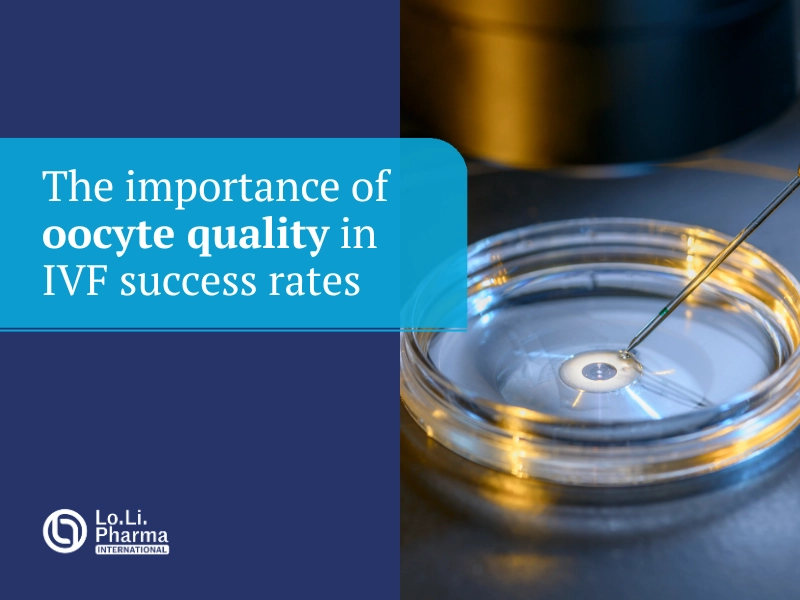
Infertility and assisted reproduction: why oocyte quality matters
Oocyte quality matters because it influences whether fertilization can lead to embryo development, implantation, and birth. Infertility is a major public-health issue: according to the World Health Organization, about one in six people experience infertility during their lifetime (World Health Organization, 2023).
More people are also seeking a first pregnancy later in reproductive life, when age-related ovarian changes become increasingly relevant. As the use of assisted reproduction and IVF grows, understanding the biological factors that shape treatment outcomes has become essential. Oocyte quality is one of these factors (Eftekhari Moghadam et al., 2022; Homer, 2024).
What “oocyte quality” means
Oocyte quality is the capacity of an egg cell to mature correctly, be fertilized, and support early embryo development. This functional capacity is also called oocyte competence.
Quality and quantity describe different aspects of ovarian biology. Ovarian reserve reflects the remaining follicle pool and helps estimate how many oocytes may be retrieved during stimulation. It does not directly show whether an individual oocyte is competent (Homer, 2024).
Competence depends on coordinated nuclear and cytoplasmic maturation. Nuclear maturation supports correct meiotic division, while cytoplasmic maturation provides the organelles, proteins, maternal RNA, and metabolic resources needed after fertilization. Granulosa cells, hormonal regulation, and the follicular microenvironment also contribute (Zhang et al., 2025). No single visible feature, laboratory value, or biomarker can fully define oocyte quality.
Why it is decisive in IVF
Oocyte quality influences fertilization, embryo cleavage, blastocyst formation, implantation, clinical pregnancy, and live birth (Eftekhari Moghadam et al., 2022).
Its effect must be interpreted within the whole treatment pathway. IVF outcomes also depend on maternal age, semen quality, stimulation protocols, endometrial receptivity, and embryology-laboratory quality. Embryo-selection methods can help identify embryos with greater developmental or implantation potential, although they cannot change the competence of the original oocyte (Nuñez-Calonge et al., 2024).
Which factors influence oocyte quality
Oocyte quality is shaped by age, chromosome stability, energy metabolism, the follicular environment, health conditions, and external exposures.
- Maternal age: The most established determinant. Ageing affects meiosis, chromosome segregation, cellular repair, and the proportion of oocytes able to support normal development (Homer, 2024).
- Ovarian reserve: A declining reserve mainly reduces oocyte number. It may coexist with lower competence, especially with age, although reserve markers do not measure quality directly.
- Aneuploidy: Errors in chromosome number can arise when meiotic control becomes less reliable, reducing the probability of normal blastocyst development and ongoing pregnancy (Eftekhari Moghadam et al., 2022).
- Mitochondrial function and energy metabolism: Oocyte maturation, spindle activity, fertilization, and early development require substantial energy. Mitochondrial dysfunction may compromise these processes (Wang et al., 2024).
- Oxidative stress and inflammation: Excess reactive oxygen species can damage DNA, proteins, lipids, and mitochondria. Inflammation may also disrupt communication between the oocyte and surrounding cells (Wang et al., 2024).
- PMOS and endometriosis: Hormonal, inflammatory, and metabolic changes may alter the follicular environment. Their effects on individual oocytes and IVF outcomes remain heterogeneous (Pan et al., 2024).
- Obesity and metabolic disturbances: Insulin resistance, altered metabolism, and systemic inflammation may affect ovarian physiology. Assessment should consider metabolic health and individual risk rather than body mass index alone (Boots et al., 2024).
- Lifestyle and environmental factors: Smoking, nutrition, sleep, physical activity, pollutants, and endocrine-disrupting chemicals are under investigation. Much of the evidence is observational, so direct effects are difficult to isolate.
How oocyte quality is assessed today
Oocyte quality is assessed indirectly. Morphological evaluation examines maturity and visible features of the cytoplasm, polar body, zona pellucida, and cumulus-oocyte complex. These observations are practical, but their predictive accuracy is limited (Eftekhari Moghadam et al., 2022).
Researchers are also studying biomarkers in follicular fluid and cumulus cells, advanced imaging, and omics approaches such as transcriptomics, proteomics, metabolomics, and lipidomics. Follicular fluid is relevant because it reflects the local environment in which the oocyte develops (Pan et al., 2024).
Artificial intelligence in embryology may combine images, developmental timing, clinical variables, and laboratory data. Applications are more advanced in embryo and blastocyst assessment, where algorithms can support ranking and reduce observer variability. Their value still depends on transparency, external validation, and links with outcomes such as live birth (Nuñez-Calonge et al., 2024).
There is still no universally accepted method that can measure the competence of an individual oocyte precisely.
Strategies under study to support ovarian function
Research areas include balanced nutrition, smoking cessation, physical activity, sleep, management of metabolic disturbances, reduction of excessive oxidative stress, personalized ovarian stimulation, and nutritional supplementation.
Mitochondria are an important target because of their role in energy production, oxidative balance, and ovarian ageing. Antioxidant strategies and interventions aimed at mitochondrial metabolism, biogenesis, and quality control are being studied, although many remain experimental (Wang et al., 2024).
Myo-inositol is among the most studied ingredients, particularly in women with PMOS. It is involved in insulin signalling and ovarian physiology. Research suggests possible benefits for selected metabolic and reproductive outcomes in PMOS, while evidence on oocyte quality and major IVF outcomes, including live birth rate, remains limited and heterogeneous (Fitz et al., 2024).
International guidance therefore treats inositol as an experimental fertility therapy and recommends shared decision-making that reflects this uncertainty (Teede et al., 2023).
Future perspectives
Future progress will depend on more accurate biomarkers and a deeper understanding of oocyte competence. Omics approaches may identify molecular signatures across oocytes, cumulus cells, and follicular fluid, while artificial intelligence could integrate these signals with imaging and clinical information (Pan et al., 2024; Zhang et al., 2025).
The most useful tools will need to be non-invasive, reproducible, externally validated, and linked to clinically meaningful outcomes. Better knowledge of meiosis, mitochondrial function, oxidative stress, and the follicular environment may support more personalized reproductive medicine and targeted strategies to preserve ovarian function.
Understanding oocyte quality more precisely could improve IVF outcomes and help clinicians tailor fertility pathways to each patient.
Bibliography:
Boots CE, Gloff M, Lustik SJ, Vitek W. Addressing weight bias in reproductive medicine: a call to revisit body mass index restrictions for in vitro fertilization treatment. Fertility and Sterility. 2024;122:204–210. DOI: 10.1016/j.fertnstert.2024.05.140
Eftekhari Moghadam AR, Taheri Moghadam M, Hemadi M, Saki G. Oocyte quality and aging. JBRA Assisted Reproduction. 2022;26(1):105–122. doi:10.5935/1518-0557.20210026.
Fitz V, Graca S, Mahalingaiah S, et al. Inositol for polycystic ovary syndrome: a systematic review and meta-analysis to inform the 2023 update of the International Evidence-based PCOS Guidelines. The Journal of Clinical Endocrinology & Metabolism. 2024;109(6):1630–1655. DOI: 10.1210/clinem/dgad762
Homer HA. Understanding oocyte ageing. Minerva Obstetrics and Gynecology. 2024;76(3):284–292. doi:10.23736/S2724-606X.24.05343-0.
Nuñez-Calonge R, Santamaria N, Rubio T, Moreno JM. Making and selecting the best embryo in in vitro fertilization. Archives of Medical Research. 2024;55:103068. 10.1016/j.arcmed.2024.103068
Pan Y, Pan C, Zhang C. Unraveling the complexity of follicular fluid: insights into its composition, function, and clinical implications. Journal of Ovarian Research. 2024;17:237. doi:10.1186/s13048-024-01551-9.
Teede HJ, Tay CT, Laven J, et al. Recommendations from the 2023 International Evidence-based Guideline for the Assessment and Management of Polycystic Ovary Syndrome. Fertility and Sterility. 2023;120(4):767–793. doi:10.1016/j.fertnstert.2023.07.025.
Wang Z-H, Wang Z-J, Liu H-C, et al. Targeting mitochondria for ovarian aging: new insights into mechanisms and therapeutic potential. Frontiers in Endocrinology. 2024;15:1417007. doi:10.3389/fendo.2024.1417007.
World Health Organization. Infertility prevalence estimates, 1990–2021. Geneva: World Health Organization; 2023.
Zhang Z, Wu T, Sang Q, Wang L. Human oocyte quality and reproductive health. Science Bulletin. 2025;70:2365–2376. doi:10.1016/j.scib.2025.04.045.