What distributors should know about hyaluronic acid moisturizers
In a survey of 3,768 postmenopausal women with vulvovaginal atrophy in Italy, Germany, Spain and the UK, vaginal dryness was the most common symptom, reported by 70%. Healthcare professionals had discussed the condition with 62% of these women, yet they had started the conversation in only 10% of cases. (Nappi et al., 2016)
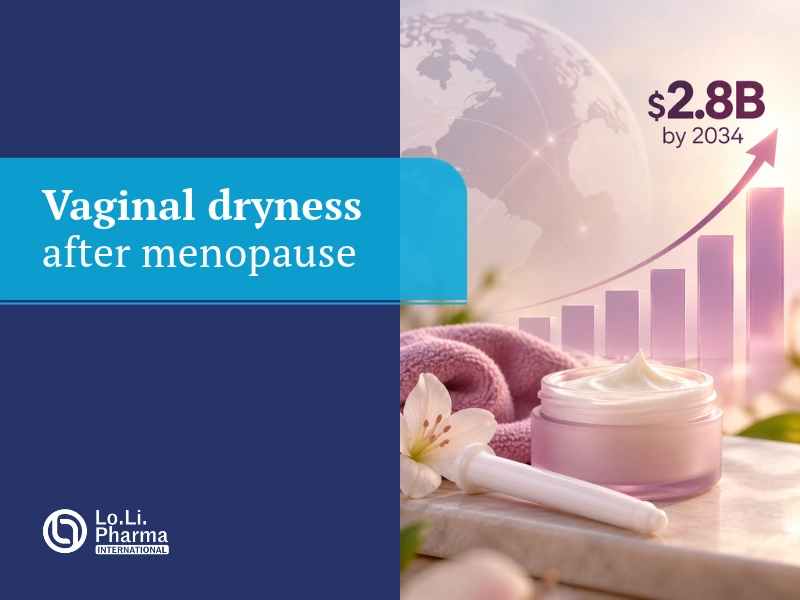
The vaginal moisturizers market is projected to reach USD 2.8 billion by 2034, according to Dataintelo, which estimates a value of USD 1.6 billion in 2025. (Dataintelo, 2025)
For women’s health distributors, the forecast draws attention to a category serving a frequently overlooked need: persistent vaginal dryness associated with menopause.
Women need to recognize symptoms, find advice they can trust and understand how local treatment fits their circumstances. Hyaluronic acid offers a non-hormonal approach to vaginal hydration, with clinical evidence that requires assessment at formulation level.
What is genitourinary syndrome of menopause?
Genitourinary syndrome of menopause, or GSM, describes genital, sexual and urinary changes associated with declining sex hormones. Symptoms can include vaginal dryness, irritation and pain during intercourse, alongside urinary complaints.
The term covers a broader clinical problem than dryness alone. The 2025 AUA/SUFU/AUGS guideline addresses recognition, diagnosis and treatment after other causes have been excluded. (Kaufman et al., 2025)
Women may attribute discomfort to aging, avoid discussing it or seek help only when it interferes with intimacy. Clear language helps professionals distinguish persistent menopausal symptoms from conditions requiring a different assessment. Education should explain which symptoms a moisturizer addresses and when medical advice is needed.
How common are GSM and vaginal dryness?
Prevalence figures depend on the population and diagnostic criteria. A 2025 multicenter study from the Indian Midlife Registry included 1,781 women older than 40 attending outpatient clinics, comprising 826 perimenopausal and 955 postmenopausal women.
GSM prevalence across the full sample was 48.5%, and vaginal dryness was reported by 26.4%. These values describe the mixed sample and should not be presented as postmenopause-only estimates. (Ashraf et al., 2025)
A 2024 study in Central India of 100 postmenopausal women attending a rural tertiary center with at least one vulvovaginal symptom reported vulvovaginal atrophy in 79% of participants, using a Vaginal Health Index score below 15, and vaginal dryness in 77%. (Ulhe et al., 2024)
These findings describe different clinical samples, definitions and settings. The European REVIVE survey cited above adds a third perspective, since it recruited women who already had symptoms of vulvovaginal atrophy. The figures should remain attached to their studies. Combining them into a worldwide prevalence range would imply a degree of comparability that the evidence does not establish.
Local partners should examine how women with these symptoms move through healthcare. Which professionals discuss vaginal dryness? How often do women receive an explanation and a management plan? The answers identify an education need before a launch strategy assumes that clinical prevalence will translate directly into purchases.
Where non-hormonal moisturizers sit in care
The North American Menopause Society (now The Menopause Society) addressed this question in its 2020 position statement on GSM. Nonhormone therapies available without a prescription provide sufficient relief for most women with mild symptoms, while low-dose vaginal estrogen, vaginal DHEA, systemic estrogen therapy and ospemifene are effective for moderate to severe GSM. (The North American Menopause Society, 2020)
The same statement notes that data are insufficient to confirm the safety of vaginal estrogen, DHEA or ospemifene in women with breast cancer, and that management should take into account the woman’s needs and her oncologist’s recommendations. (The North American Menopause Society, 2020)
Women with a history of breast cancer, along with women who prefer to avoid hormones, are therefore a relevant group for non-hormonal moisturizers. Any recommendation for them belongs with the clinicians who manage their care.
How hyaluronic acid supports vaginal hydration
Hyaluronic acid is a water-binding molecule used in vaginal formulations to support local hydration. Applied as a moisturizer, its purpose is to help relieve dryness through a physical hydration mechanism. Product performance depends on the complete formulation and the way it is used.
In a randomized pilot trial published in 2024, Agrawal and colleagues assigned 49 women with GSM to vaginal hyaluronic acid suppositories or vaginal estrogen cream; 45 provided data at week 12. Both groups improved, with no observed difference in the overall vulvovaginal symptom questionnaire score. (Agrawal et al., 2024)
The small sample and limited duration prevent the trial from establishing definitive long-term equivalence.
A 2023 systematic review found improvements with both hyaluronic acid and topical estrogen, while several comparisons favored estrogen. The authors identified variation in study methods and outcomes. (Albalawi et al., 2023)
The evidence supports consideration of hyaluronic acid as a non-hormonal option, while leaving important questions about equivalence and durability unresolved.
A systematic review published in Annals of Internal Medicine in 2024 identified 46 randomized trials and found that vaginal moisturizers may improve dryness, with low certainty of evidence. Long-term efficacy and safety data were limited. (Danan et al., 2024)
This is a reason to examine the exact product data and keep claims proportionate to the measured outcomes.
Moisturizers and lubricants address different needs
A vaginal moisturizer is generally used regularly to manage ongoing dryness. A lubricant is used around sexual activity to reduce friction. A woman may use both, depending on symptoms and advice. This distinction helps prevent disappointment when an occasional lubricant is expected to address persistent discomfort. (Cuccu et al., 2024)
Formulation characteristics matter too. A 2024 review by Cuccu and colleagues discusses the relevance of pH and osmolality when selecting vaginal products. (Cuccu et al., 2024) Buyers should assess suitability for vaginal use and the tolerability of the finished product, alongside its ingredients.
The World Health Organization gives concrete reference values. Its advisory note on personal lubricants recommends an osmolality that ideally stays below 380 mOsm/kg and does not exceed 1,200 mOsm/kg, and a pH close to that of the healthy vagina, around 3.8 to 4.5. (World Health Organization, 2012) The note was written for lubricants, yet the same values give buyers a practical benchmark when they review the technical file of a moisturizer.
What the market forecast means for distributors
Dataintelo’s USD 2.8 billion projection is a commercial estimate for vaginal moisturizers. Reports covering moisturizers and lubricants together measure a different category. Their values should be compared only after checking product scope, geography and base year.
For buyers, a defensible launch requires answers to practical questions:
- Does the clinical dossier evaluate the finished formulation for vaginal dryness?
- Are the instructions clear about application and regular use?
- What tolerability data support the intended population?
- How will local professionals explain persistent symptoms and appropriate referral?
Packaging and price deserve attention because regular application must be manageable. A product can have a plausible mechanism yet fail to meet users’ needs if instructions are confusing or continued use is unaffordable.
Regulatory status shapes the rest of the conversation. In the European Union, vaginal moisturizers are usually placed on the market as medical devices under Regulation (EU) 2017/745 (MDR). The dossier a buyer should expect therefore centers on clinical evaluation and CE marking, and the device’s intended purpose defines both the claims allowed and the channels where it can be sold.
Where our hyaluronic acid formulations fit
Lo.Li. Pharma International works with low molecular weight hyaluronic acid in two forms. The first is a class IIa medical device delivered as vaginal suppositories. Five clinical trials and one systematic review have evaluated it. One trial assessed vaginal atrophy in menopausal women, three looked at the prevention of acute side effects in women receiving radiotherapy after cervical surgery, and one combined the suppositories with an oral supplement.
That oral supplement contains ultra low molecular weight hyaluronic acid. Three clinical trials in postmenopausal women with vaginal atrophy have reported changes in the vaginal epithelium and less itching and dyspareunia. Two further trials studied radiotherapy-induced cystitis.
The data cover different populations and settings, and each product has to be judged on the studies that used it. For a distributor, the useful question is which of these settings matches the local need: women with menopausal dryness who prefer to avoid hormones, women with a history of cancer followed by their oncologist, or pelvic radiotherapy programs.
Lo.Li. Pharma International’s emphasis on clinical validation and medical education supports a review of the relevant formulation dossier.
Distributors can request the dossier, including the clinical evaluation and technical data on pH and osmolality, to check it against local registration requirements, or book a call with our medical team to discuss positioning and patient information, through our contact page.
Bibliography:
Nappi RE, Palacios S, Panay N, Particco M, Krychman ML. Vulvar and vaginal atrophy in four European countries: evidence from the European REVIVE Survey. Climacteric. 2016;19(2):188-197. https://doi.org/10.3109/13697137.2015.1107039
Dataintelo. Vaginal moisturizer market size, share & forecast report 2025 to 2034. Market report. 2025. Accessed 14 October 2026. https://dataintelo.com/report/global-vaginal-moisturizer-market
Kaufman MR, Ackerman AL, Amin KA, et al. The AUA/SUFU/AUGS guideline on genitourinary syndrome of menopause. J Urol. 2025;214(3):242-250. https://doi.org/10.1097/JU.0000000000004589
Ashraf AB, Meeta M, Chitra AB, et al. Genitourinary syndrome of menopause: a multicenter study from the Indian Midlife Registry. Climacteric. 2025;28(3):329-336. https://doi.org/10.1080/13697137.2025.2496681
Ulhe SC, Acharya N, Vats A, et al. Study of vulvovaginal atrophy and genitourinary syndrome of menopause and its impact on the quality of life of postmenopausal women in Central India. Cureus. 2024;16(2):e54802. https://doi.org/10.7759/cureus.54802
The North American Menopause Society. The 2020 genitourinary syndrome of menopause position statement of The North American Menopause Society. Menopause. 2020;27(9):976-992. https://doi.org/10.1097/GME.0000000000001609
Agrawal S, LaPier Z, Nagpal S, et al. A randomized, pilot trial comparing vaginal hyaluronic acid to vaginal estrogen for the treatment of genitourinary syndrome of menopause. Menopause. 2024;31(9):750-755. https://doi.org/10.1097/GME.0000000000002390
Albalawi NS, Almohammadi MA, Albalawi AR. Comparison of the efficacy of vaginal hyaluronic acid to estrogen for the treatment of vaginal atrophy in postmenopausal women: a systematic review. Cureus. 2023;15(8):e44191. https://doi.org/10.7759/cureus.44191
Danan ER, Sowerby C, Ullman KE, et al. Hormonal treatments and vaginal moisturizers for genitourinary syndrome of menopause: a systematic review. Ann Intern Med. 2024;177(10):1400-1414. https://doi.org/10.7326/ANNALS-24-00610
Cuccu I, Golia D’Augè T, Firulli I, et al. Update on genitourinary syndrome of menopause: a scoping review of a tailored treatment-based approach. Life (Basel). 2024;14(11):1504. https://doi.org/10.3390/life14111504
World Health Organization, UNFPA, FHI 360. Use and procurement of additional lubricants for male and female condoms: WHO/UNFPA/FHI360 advisory note. Geneva: World Health Organization; 2012.